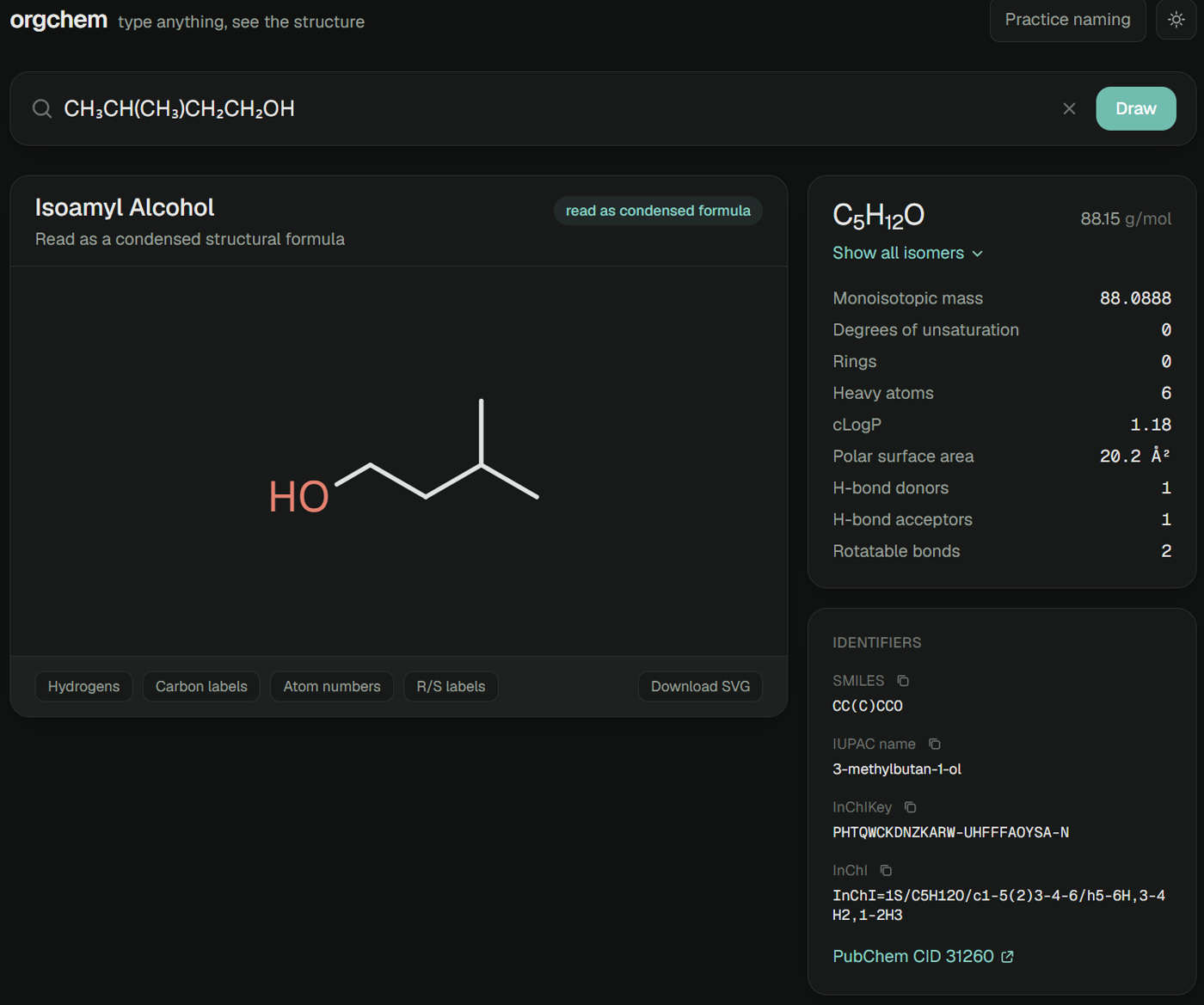
Type anything that names or describes an organic compound and see its structure. IUPAC names, common and trade names, SMILES and molecular formulas all resolve, but the part no other service handles is condensed structural formulas — the notation people actually write by hand — so that parser is the heart of it.
It is valence driven, which is what lets it settle the notation's ambiguities without guessing. Whether the bracket in CH₃CH(CH₃)CH₃ is a branch and the one in CH₃(CH₂)₃CH₃ a repeat unit falls out of which atoms have valence spare; whether an OH continues a chain or hangs off it falls out of the fact that OH cannot carry what follows. A formula written with no hydrogens at all is read as SMILES first, because CCO is ethanol one way and acetaldehyde the other and both draw perfectly well — which reading is asked for first is the whole answer.
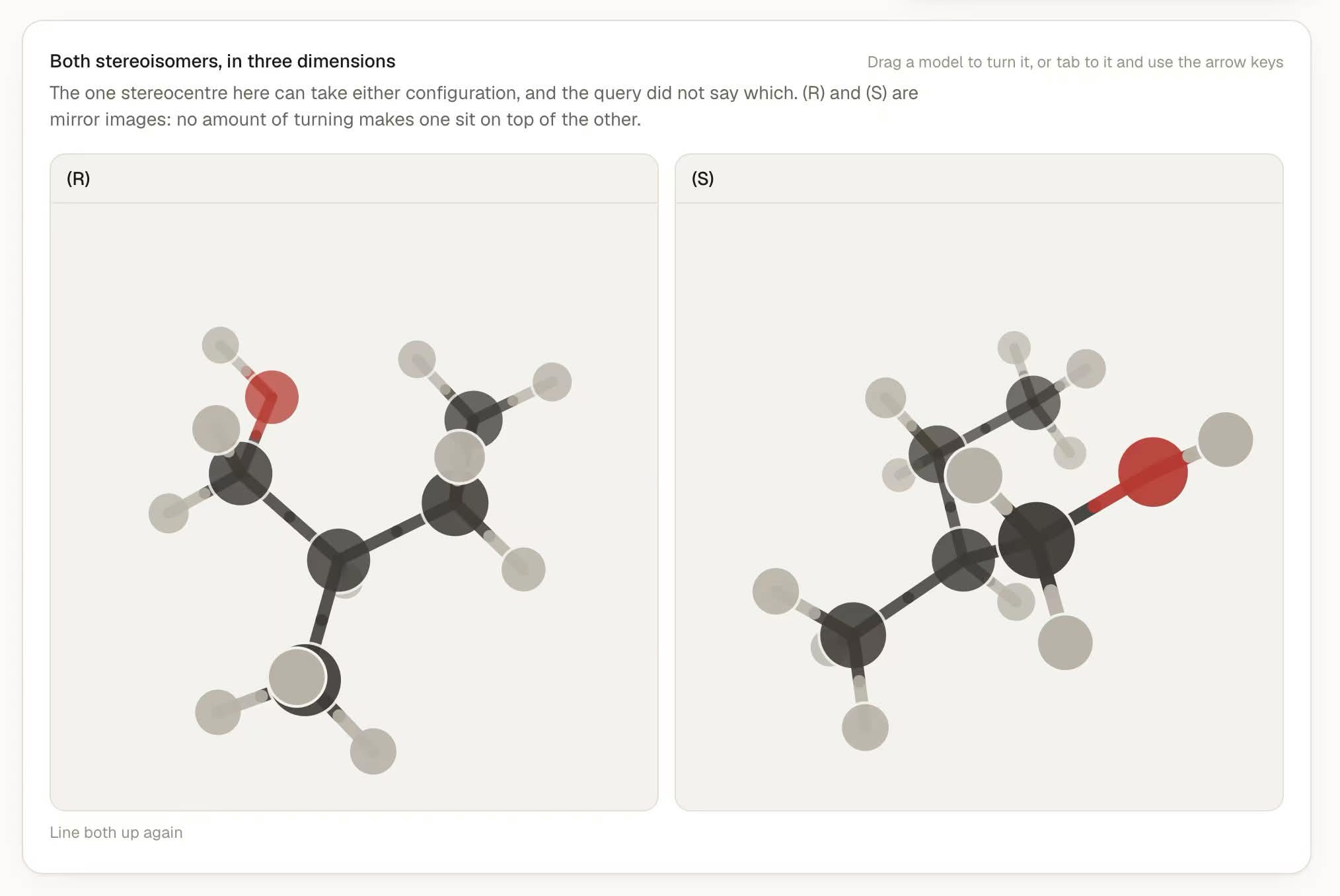
Ambiguity is shown rather than resolved silently. A molecular formula does not name a structure, so C₅H₁₂ lists its isomers instead of picking one. Where a structure has exactly one stereogenic element both isomers are built, given 3D coordinates and drawn as ball-and-stick models that turn independently; orientation is held as a rotation matrix rather than a pair of angles, so the models turn freely instead of jamming at the poles.
The practice mode drills 283 structures in both directions, filtered by topic and level. Typed answers are marked by resolving them back into a structure and comparing it with the one shown rather than by matching a string, so 2-propanol, isopropyl alcohol and propan-2-ol all pass, and naming the right skeleton with the wrong configuration is reported as that rather than simply marked wrong. The answer stays on the server: an option is identified only by its position, and the server rebuilds the list from the question and a nonce, so nothing in what is sent distinguishes the right drawing from the other three.
Screens